The year 2024-25 has been a year of purposeful growth for BRIC-inStem. Since its inception, BRIC-inStem has built a proud legacy as India’s premier hub for stem cell science, regenerative medicine and science-for-society driven translation. I am proud to present this Annual Report which documents how we have progressed with clear direction and renewed energy to take us to heights yet unseen. This year’s achievements reflect our expanding scientific horizons as well as the evolution of our institutional and administrative structures, enabling us to support impactful programmes, deepen collaborations and accelerate innovation.
BRIC-inStem’s extraordinary capacity rests on our robust foundations of scholarly expertise, world-class training, state-of-the-art research facilities and fostering innovation. Our new initiatives this year build on these foundations and our rich scientific legacy, guided by our motto Without Barriers; Across Disciplines.
During the pandemic, BRIC-inStem rose to the challenge along with our BLiSC partners, to provide fast and reliable testing. At the zenith, we handled 10% of Karnataka’s testing effort. Building on that vital national effort, we have now set up our state-of-the-art Biosafety Level-3 (BSL-3) Facility. Established under the National One Health Mission, this facility will enhance India’s preparedness for future infectious disease threats. It will support advanced research, rapid diagnostics and the development of infection and disease models propelling vaccine and therapeutics development.
Our flagship institutional programmes ESCORT (Platform Enabling Stem Cell and Organoid Research and Training) and WoRtH (Programme in Women’s Reproductive Health) continue to advance, deepening their impact and laying the groundwork for new exciting possibilities.
ESCORT, recognised under the DBT-SAHAJ scheme, is establishing a catalogue of human embryonic stem cell lines, iPSC lines and engineered reporter lines to drive organoid and developmental biology research. The programme is creating scalable, automated workflows for stem cell culture, differentiation and organoid-based modelling, tackling cost and accessibility barriers in the field. These capabilities are now being applied across brain, cardiovascular, hematopoietic and lung development and disease modelling. A core thrust is on world-class training to help build expertise and industry-aligned skills. This momentum has enabled the creation of inStem PluS (Pluripotent Stem Cell Bank) which seeks to develop a repository of high-quality, ethically sourced pluripotent stem cells representing diverse Indian populations. inStem PluS will enhance national research capacity and create new opportunities for commercialisation and global engagement.
In parallel, WoRtH is actively expanding our women’s health focus. The reproductive system plays a central role in women’s health and there is poor understanding of early human development, which makes de-risking of new women’s health interventions difficult. WoRtH is catalysing research into human stem cell and organoid models that will help mitigate the risks associated with drug development. Using indigenous stem cell lines and developing reagents and substrates, we aim to provide robust laboratory models and reliable high-throughput systems for evaluating and de-risking candidate molecules. This project can shape a sustainable pipeline of stem cell-based applications for women’s reproductive health and expand available choices.
Our collective experiences from ESCORT and WoRtH have directly contributed to our latest endeavour: Centre for Research, Application and Training in Embryology (CReATE). A unit of BRIC-inStem, CReATE is dedicated to expanding our scientific understanding of early human development. The innovative research emerging from this Centre will deepen insights into developmental disorders and congenital anomalies, with implications for progressing technology and guiding new therapeutic approaches. Beyond research, this unique Centre will play a key role in training and in fostering partnerships and collaborations.
A momentous occasion this year has been the gracious visit of Dr. Jitendra Singh, Hon’ble Union Minister of State for Science and Technology (I/C) in April 2025. The Hon’ble Minister reviewed these three key initiatives: CReATE, inStem PluS and BSL-3 facility, each aimed at advancing our research capabilities and the Indian biotechnology R&D landscape. These initiatives align with the National BioE3 (Biotechnology for Economy, Environment and Employment) Policy, approved by the Union Cabinet on August 24, 2024. The Hon’ble Minister was accompanied by Dr. Rajesh Gokhale, Secretary, Department of Biotechnology (DBT), Ministry of Science and Technology, Govt. of India, senior officials from DBT and other distinguished scientists and academicians.
“An institute like this (BRIC-inStem) is going to be perhaps one of the torchbearers of the new (bio-economy) revolution”
– Dr. Jitendra Singh, Hon’ble Union Minister of State for Science and Technology (I/C) during his visit to BRIC-inStem (24 April 2025)
In 2025, BRIC-inStem endeavoured into outer space – a significant milestone in our journey. Dr. Arvind Ramanathan’s myogenesis experiment was selected to be a part of the Indian Microgravity Research Portfolio for the Axiom-4 mission in June 2025. It is a matter of immense pride that the experiment was performed aboard the International Space Station by Gaganyatri Group Captain Shubhanshu Shukla. The study examines how muscle stem cells respond to microgravity and whether nutrient supplements support muscle regeneration. We acknowledge the DBT-ISRO Joint Partnership in Space Biotechnology for enabling this work and look forward to contributing to the exciting domain of space biology. Our engagement with ISRO was further strengthened when Dr. V. Narayanan, Chairman, ISRO & Secretary, Department of Space, Govt. of India joined us as Chief Guest for the 17th Foundation Day on 29 August 2025.
We have consistently demonstrated the zeal to bridge the gap between bench and market. In translational research, I am pleased to report two major achievements in the past year. In December 2024, Kisan KavachTM, the world’s first anti-pesticide bodysuit developed in Prof. Praveen K. Vemula’s lab was launched by Dr. Jitendra Singh, Hon’ble Union Minister of State for Science and Technology (I/C). This product, commercialised in collaboration with our spin off company Sepio Health Pvt. Ltd., is being by farmers across the country protecting them from toxic pesticide exposure. Our clinical translation unit, Centre for Stem Cell Research (CSCR), Vellore successfully conducted India’s first-in-human gene therapy trial against Haemophilia A. The trial showed sustained Factor VIII expression and no bleeding episodes post-treatment. It is a shining example of India-centric innovations in vector design, manufacturing and regulatory compliance.
We have also expanded our research domains. We are delighted to welcome Dr. Indumathi Mariappan, Dr. Barun Mahata and Dr. Srinivas Animireddy, our newly joined faculty who reflect our thrust towards translational research in gene therapies and genome editing. We also welcome Prof. Nihal Thomas, a distinguished endocrinologist, who has taken up the mantle of Centre Head of CSCR, Vellore.
Throughout the year, events and activities continued on our vibrant campus. In March 2025, we hosted the CEO and members of the Board of Bill & Melinda Gates Foundation (BMGF) which has been a partner in our women’s health initiatives. We strengthened our external collaborations by hosting visits from Dr. S. Kalyanaraman, CEO, ANRF; Dr. Ryoichiro Kageyama, Director of RIKEN BDR (Japan); and Vihar Patel from International Society for Stem Cell Research (ISSCR). Deepening our ties with sister BRIC institutes, we welcomed Prof. Chandrabhas Narayana, former Director, BRIC-RGCB and Prof. Ullas Kolthur-Seetharam, Director, BRIC-CDFD. We also hosted Dr. Chris Elias, President, Global Development at BMGF who reviewed our ongoing women’s health focus programmes.
True to our goal to empower young scientists, we organised a series of lectures, seminars and workshops throughout the year. This includes our flagship two-part Workshop on Human Pluripotent Stem Cell Culture conducted in collaboration with the International Stem Cell Banking Initiative (ISCBI), Inter Interdisciplinary Local Interactions (IDLI) lectures, Summer Research Fellowship (SuRF) programme and workshops on our technology platforms. CSCR held the 10th edition of the Annual Cell and Gene Therapy Symposium which was inaugurated by Hon’ble Minister of State for Science and Technology (I/C) Dr. Jitendra Singh. We continued our outreach and science communication activities through open days, school/college visits and participation in national and international science exhibitions ensuring our science is taken beyond the labs and is accessible to the public.
“What’s being done here (at BRIC-inStem) should echo across the country—not for publicity, but because the nation needs it”
– Dr. Jitendra Singh, Hon’ble Union Minister of State for Science and Technology (I/C) during his visit to BRIC-inStem (24 April 2025)
Our cutting-edge work continues to inspire and yield results across domains. BRIC-inStem was conferred with the 2024 CII Award for Excellence in Women in STEM for our efforts in fostering gender equity. Our faculty, Dr. Bhavana Muralidharan has been selected as EMBO Global Investigator. Our Dean (Research), Prof. Praveen Vemula received the Chemical Research Society of India-Bronze Medal 2025 for developing innovative chemical technologies for solving unmet clinical needs and was recently awarded the Sun Pharma Science Foundation Research Fellowship 2025 in the area of Pharmaceutical Sciences. Dr. Reena Singh and Dr. Srinivas Repudi have received ANRF-Prime Minister Early Career Research Grant. Our students also continue to bring laurels. Swagata Adhikari was a finalist in TNQ Inspiring Science Award 2025 and Paulomi Dey won the Biotechnology Ignition Grant (BIG) from BIRAC and C-CAMP, among others.
With each new day, BRIC-inStem moves towards the frontlines of tomorrow’s biotechnology landscape. With our evolving role at the critical intersection of biology and technology, we are poised to help shape the next phase of India’s scientific and bio-economy landscape. We extend our heartfelt thanks to our students, researchers, staff, faculty and our collaborators and partners worldwide whose commitment continue to propel this young institute toward an ambitious and exciting future. We acknowledge BRIC and the Department of Biotechnology, Govt. of India for their unwavering guidance and facilitation that has made this journey possible. We look forward to their continued support as we expand our scientific ambitions and do our bit for boosting India’s growing bio-innovation ecosystem.
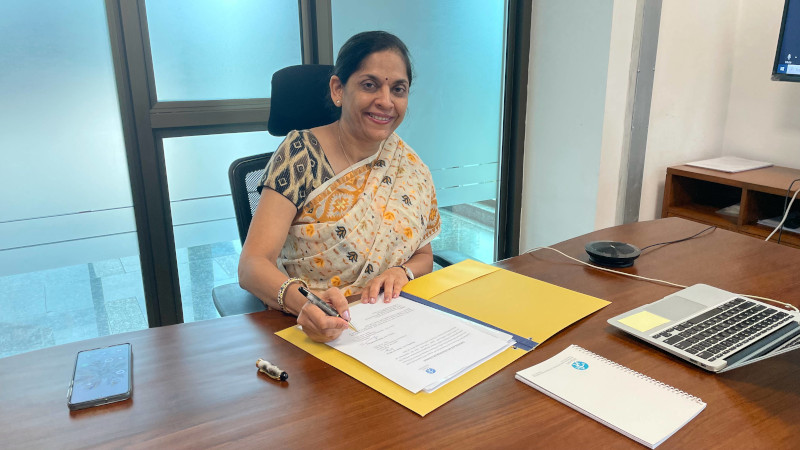
Maneesha S Inamdar
Director
BRIC-inStem