
Epithelial structure is actively regulated and adapts during repair and disease.
The airway epithelium forms a specialized protective barrier that defends the lung against inhaled particles, pathogens, and environmental injury. Multiple epithelial cell types cooperate to maintain this barrier and support tissue repair. Among these, multiciliated cells promote mucociliary clearance through coordinated ciliary beating that removes mucus and trapped debris from the airways.
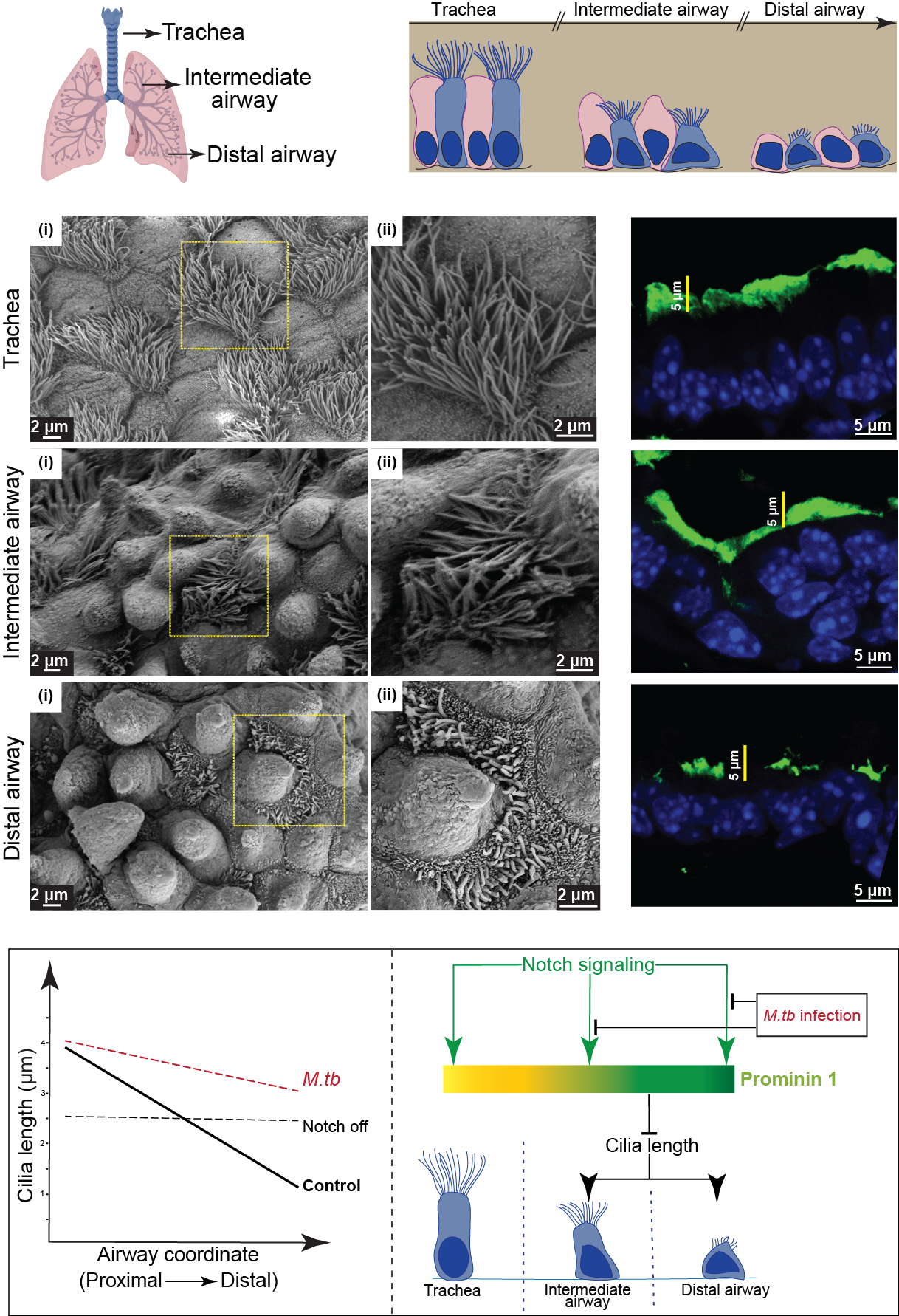
Ciliary length progressively decreases along the proximal–distal axis of the tracheobronchial tree, but the mechanisms that establish and maintain this regional gradient have remained poorly understood. We have shown that canonical Notch signaling within multiciliated cells actively regulates regional ciliary architecture and stabilizes the proximal–distal gradient in ciliary length. Inhibition of Notch signaling shortens tracheal cilia, elongates distal airway cilia, abolishes regional differences in ciliary length, and induces location-specific transcriptional changes.
To investigate how environmental perturbations influence this regulatory system, we examined germ-free mice and a model of Mycobacterium tuberculosis infection. Germ-free conditions did not significantly alter ciliary architecture, whereas M. tuberculosis infection caused elongation of distal airway cilia accompanied by reduced Notch signaling. These findings identify Notch signaling as a central homeostatic regulator of airway ciliary morphology.
Ongoing projects investigate how ciliary remodeling is regulated during lung injury and infection, the molecular mechanisms underlying these changes, and their consequences for mucociliary clearance and airway defense.