
Niche signals instruct distinctive plasticity programs within otherwise similar epithelial cells.
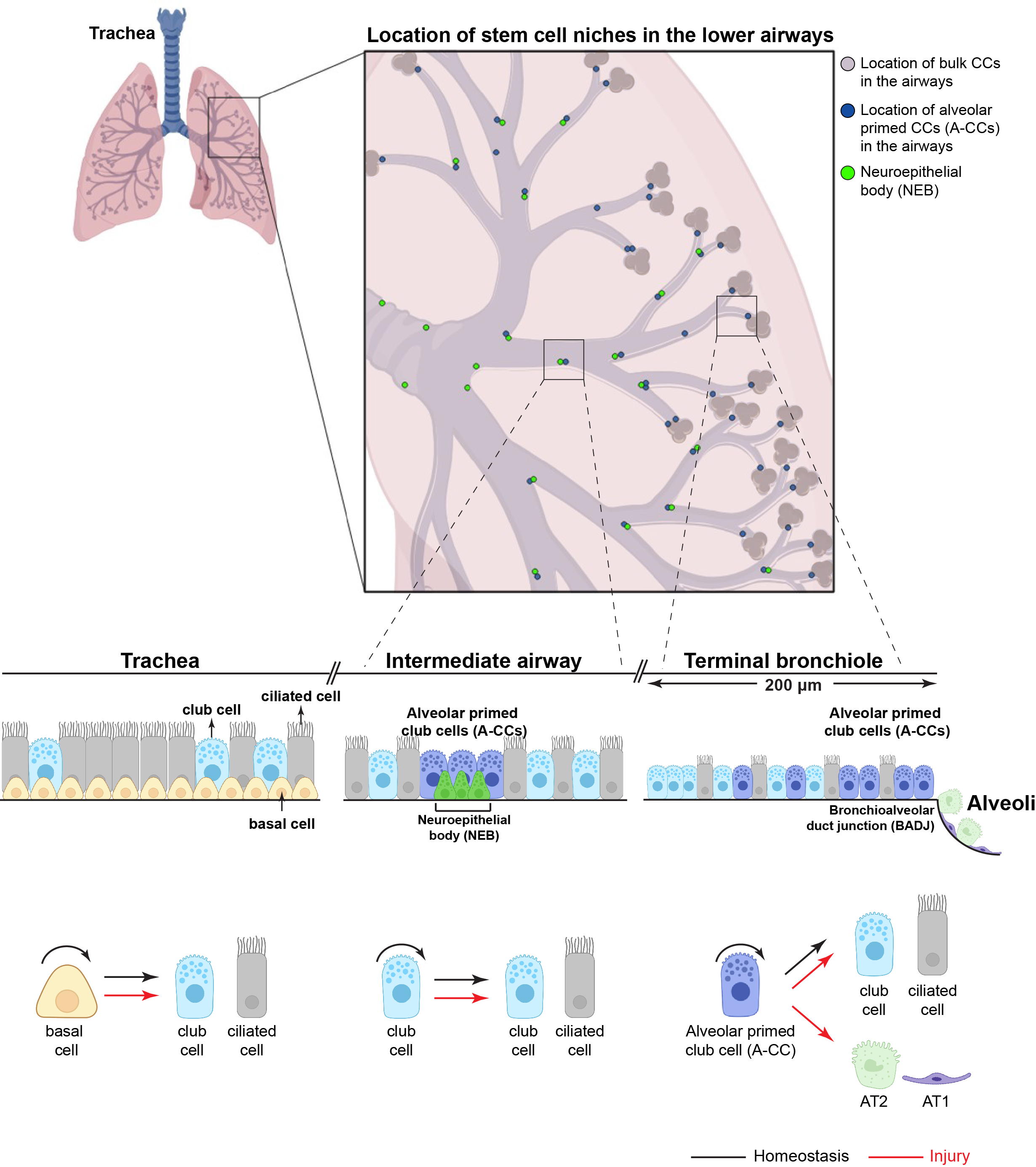
Airway repair is carried out by multiple progenitor populations that occupy distinct regions of the lung. Some, such as basal cells in the upper airways, function as dedicated stem cells similar to those found in stratified epithelia like the skin. Others, including secretory (club) cells distributed throughout the airways, primarily perform physiological functions during normal homeostasis but can re-enter the cell cycle and regenerate damaged epithelium after injury.
Our laboratory studies specialized club cell populations located within discrete airway niches: cells associated with neuroepithelial bodies (NEBs) at airway branchpoints, and cells located at terminal bronchioles near the airway–alveolar interface.
We have shown that club cells within these microenvironments exhibit regenerative potential that differs from those of club cells elsewhere in the airway epithelium. In particular, progenitors located at the airway–alveolar interface can contribute to both airway and alveolar repair following injury and may play important roles in the resolution of alveolar fibrosis.
Our ongoing work asks how these region-specific plasticity programs are established during development, how local niche-derived signals regulate lineage competence, and how injury and fibrosis reveal latent regenerative potential.