
Plasticity can be hard-wired into developmental programs and executed through intrinsic signaling logic.
The adult tracheal (respiratory) system of Drosophila arises from two distinct progenitor populations during metamorphosis.
One population consists of dedicated adult progenitor cells that are specified during embryogenesis, maintained through larval life, and activated during metamorphosis to generate adult tissues such as the wings, legs, and portions of the adult tracheal system.
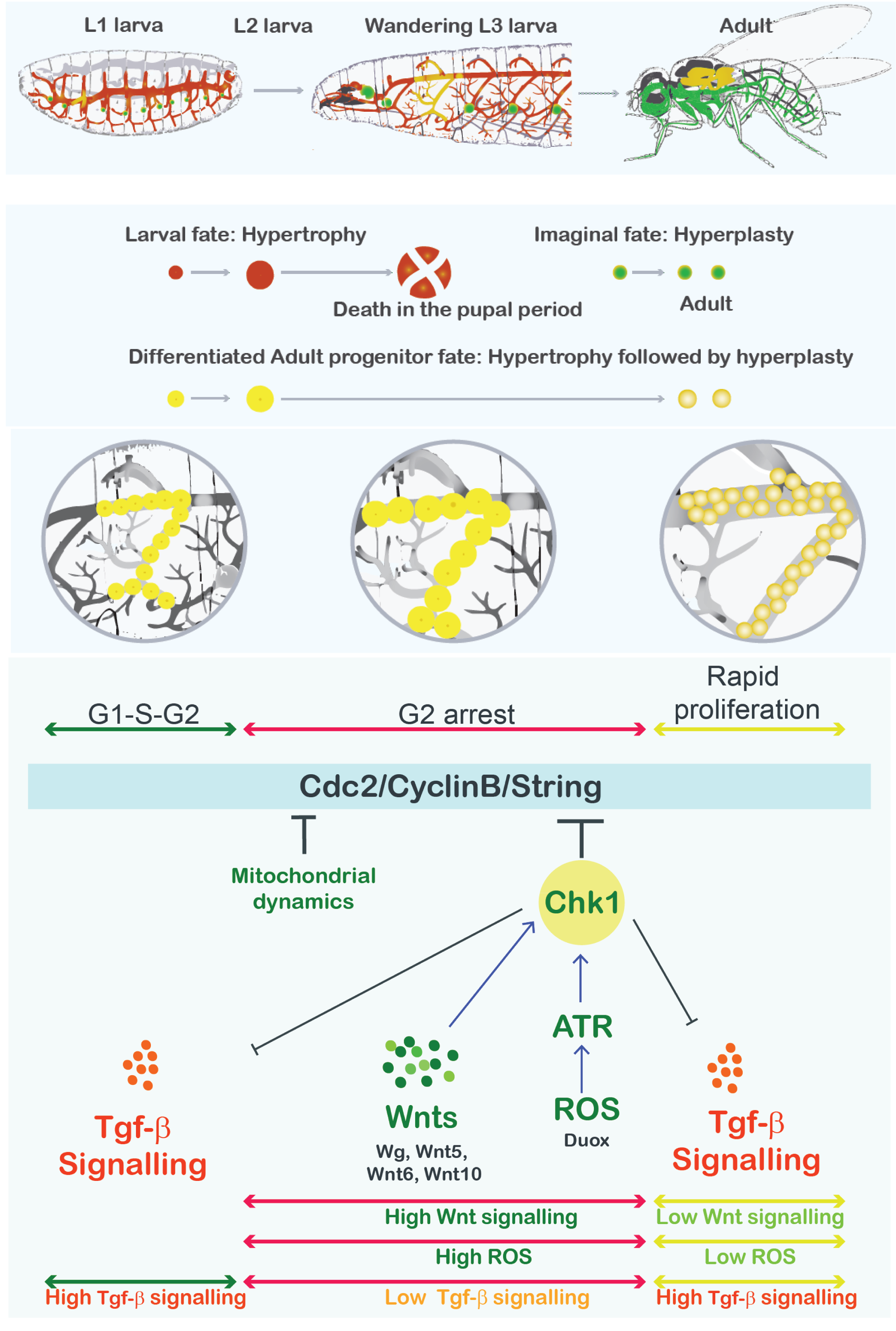
A second population arises from differentiated larval tracheal cells. Unlike most larval tracheal cells, which are post-mitotic, these differentiated progenitors undergo hypertrophic growth during larval stages while continuing to perform larval respiratory functions. Late in larval development, they re-enter the cell cycle and proliferate extensively to generate the adult tracheal system.
Our laboratory studies how these differentiated progenitor cells are maintained in a poised, non-dividing state and how they are subsequently triggered to proliferate.
We have shown that progenitor fate is developmentally controlled through the coordinated activity of multiple signaling pathways. During larval stages, Wnt signaling maintains cells in a prolonged G2 arrest. Multiple Wnt ligands act synergistically to elevate levels of Checkpoint Kinase 1 (Chk1). In parallel, reactive oxygen species (ROS) generated by Duox activate ATR, which phosphorylates Chk1 and co-opts a canonical DNA damage checkpoint program to maintain mitotic arrest.
At the onset of metamorphosis, Wnt and ROS signaling decline, relieving checkpoint-mediated arrest and permitting mitotic entry. This transition is accompanied by activation of TGF-β signaling, which drives rapid proliferative expansion of the differentiated progenitor population.
Ongoing projects investigate how ROS activates ATR-dependent Chk1 phosphorylation and how this pathway coordinates cellular growth with proliferative re-entry.
The use of multiple progenitor classes during tissue remodeling, as exemplified by the metamorphosis of the Drosophila tracheal system, appears to be a broadly conserved developmental strategy across tissues and organisms, including the mammalian lung.